Not Just Another Gaming App: The Law, Your Brain and the Vault
Is a paid puzzle game allowed in India? Is it actually good for you? Here are straight answers to both.
The Crack the Vault crew ·
"Isn't this just another gaming app?"
We hear it, and it's a fair question. Plenty of apps are built to drain your wallet and your evening. So let's tackle the two questions that matter: where a game like Crack the Vault stands under India's gaming law, and what it actually does to your brain.
The law, in plain English
In August 2025, India's Parliament passed the Promotion and Regulation of Online Gaming Act, 2025. Its Rules took effect on 1 May 2026, and a new regulator, the Online Gaming Authority of India, now oversees the sector.
The law sorts online games into three buckets:
- E-sports: organised competitive games recognised under the National Sports Governance Act, 2025. Allowed, with registration.
- Online social games: games offered for entertainment, recreation or skill development. Allowed.
- Online money games: banned outright.
The key definition is the third one. An online money game is one where a user pays fees, or deposits money or other stakes, expecting to win money or other enrichment in return.
Here's the twist many people miss: it doesn't matter whether the game is based on skill, chance or both. The old "it's a game of skill, so it's fine" argument no longer works. If money goes in with an expectation of money coming out, it's a money game. Offering one can mean up to three years in prison and a fine of up to ₹1 crore.
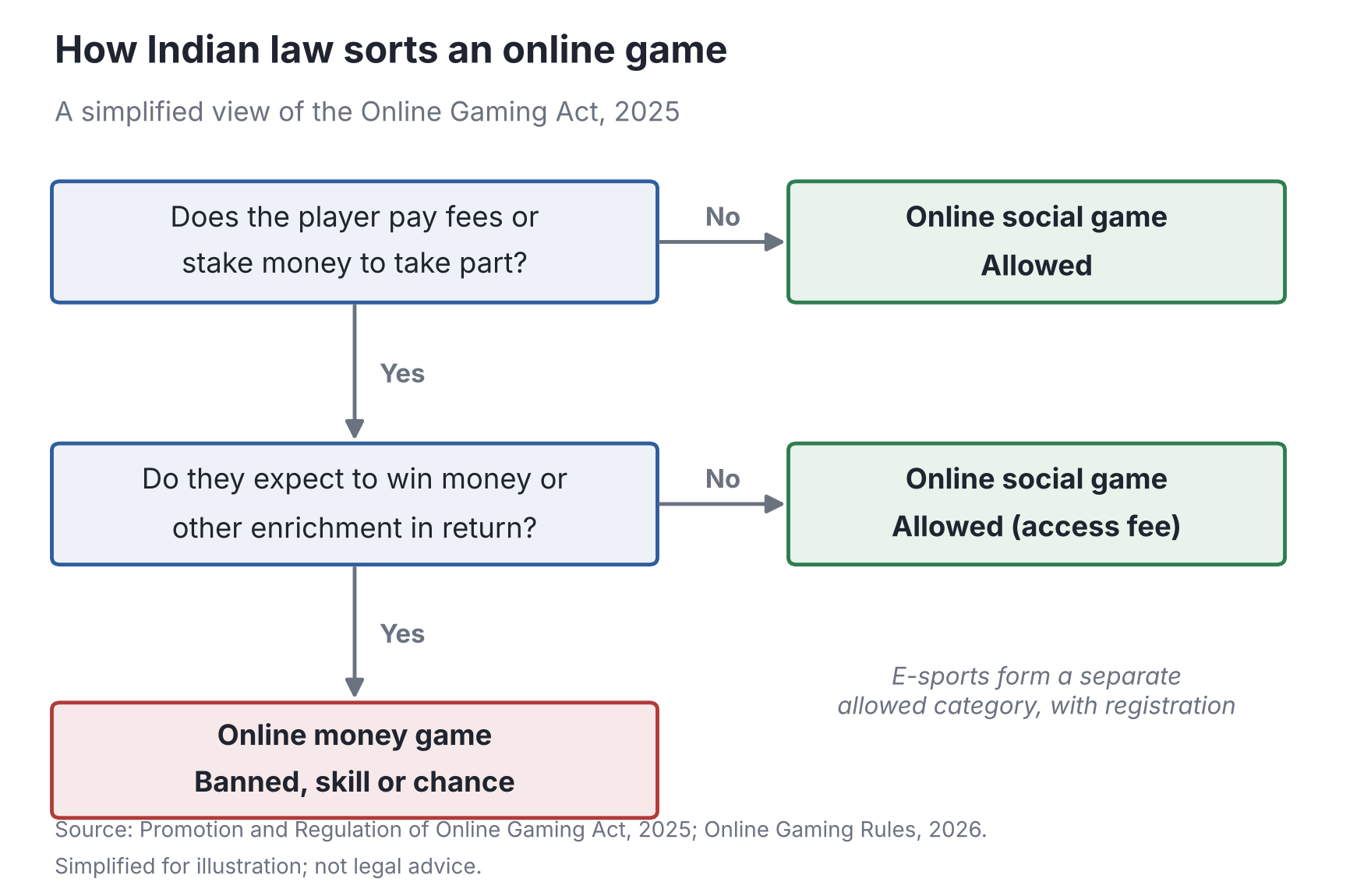
The two questions that decide which side of the line a game falls on.
So can a game charge you at all? Yes. The Act allows online social games to charge a subscription fee or a one-time access fee, as long as that payment isn't a stake or a wager. When deciding which side of the line a game falls on, the regulator looks at factors such as whether players pay to take part, whether they expect monetary winnings, how the platform makes its money, and whether rewards can be redeemed or cashed in outside the game.
Where Crack the Vault fits
Crack the Vault is built as a skill-based puzzle game. Vaults 1 and 2 are free with no sign-up, and vault 3 just needs a free account. Vaults 4 to 10 are part of Pro, and they're free during early access. When paid tiers arrive, they'll be access fees for harder content, the same way you'd buy a puzzle book or a course. You pay to play more, never to win money.
As we plan sponsor rewards for the future, we're designing them with this framework in mind from day one, not as an afterthought. We'll be upfront about exactly how rewards work before we roll them out.
One honest note: this post explains the law in general terms. It isn't legal advice.
What a vault does to your brain
Now the fun part. Every lock is a tiny workout. To crack one, you have to:
- Spot patterns in riddles, sequences and number puzzles
- Hold information in your head while you test possibilities
- Make decisions under pressure, with a clock running and limited lives
- Judge when to use a hint and when to push on alone
That's not passive scrolling. That's active thinking.
Research backs the idea that puzzles and brains get along. A study of more than 19,000 adults aged 50 and over, led by the University of Exeter and King's College London, found that the more regularly people did word and number puzzles, the better they performed on tests of memory, attention and reasoning. Regular word-puzzle users performed like people about ten years younger on grammatical reasoning and eight years younger on short-term memory.
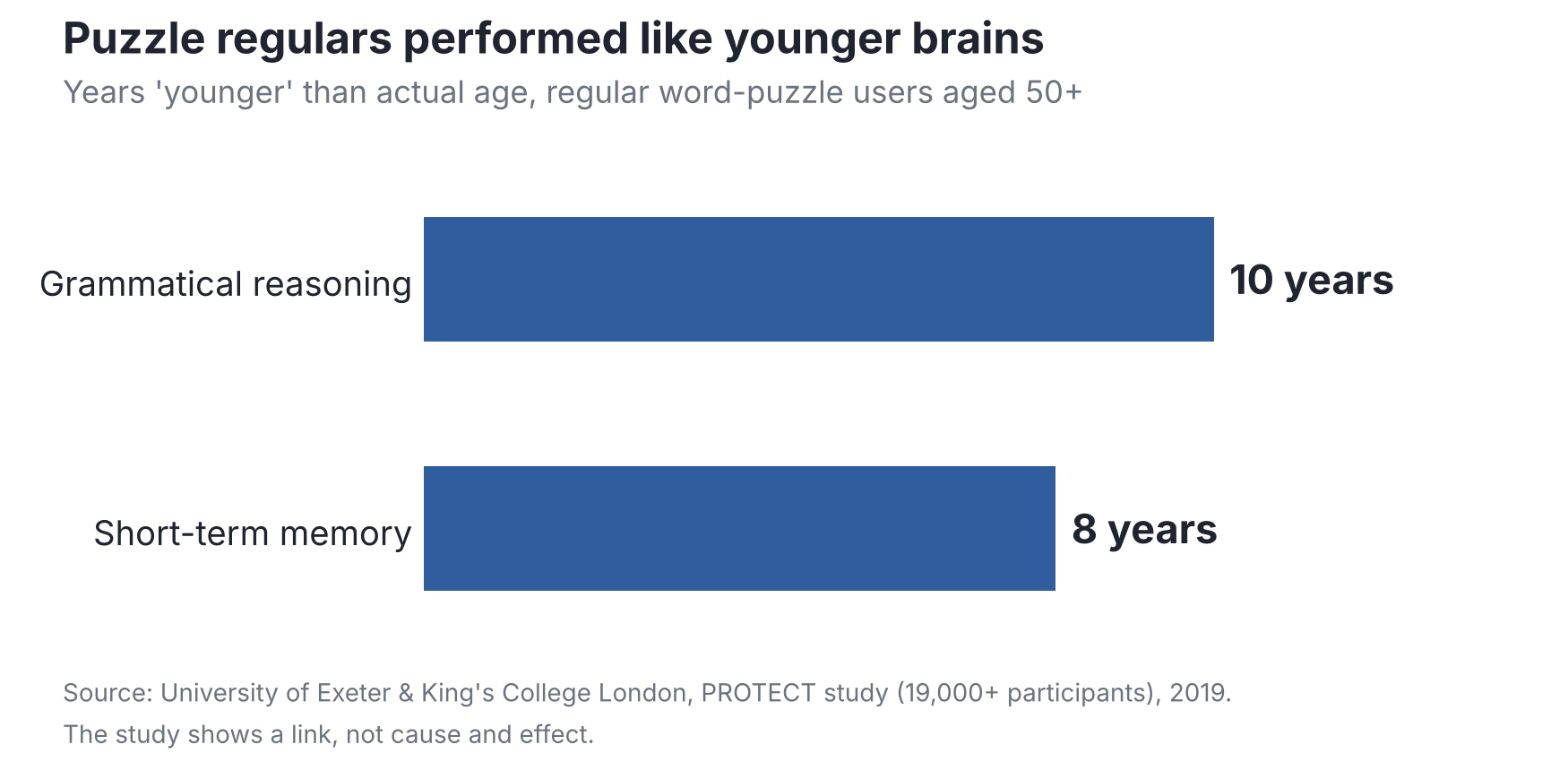
How much "younger" regular word-puzzle users performed on two cognitive tests.
A fair caveat: that study shows a link, not proof that puzzles cause sharper thinking. The researchers say so themselves.
There's evidence from younger players too. In a 2015 study in the journal Computers & Education, Florida State University researchers randomly assigned 77 undergraduates to play either Portal 2, a puzzle video game, or Lumosity, a brain-training program, for eight hours. The Portal 2 group came out ahead on all three measures tested: problem solving, spatial skills and persistence.
That last one matters most. Persistence is the skill of sticking with a hard problem when quitting is easier. It's exactly what a ticking vault demands.
Time spent vs time wasted
Not all screen time is equal. Twenty minutes on a puzzle that makes you reason, adapt and recover from mistakes is a very different activity from twenty minutes of scrolling. One leaves you sharper. The other leaves you wondering where the evening went.
The difference isn't the screen. It's whether your brain is driving or just along for the ride.
We built Crack the Vault for people who want their play to count. It's fun, it's tense, and it's designed to make you think. A few habits we recommend:
- Play in short, focused sessions
- Treat wrong answers as data, not defeat
- Set your own limits, because a sharp mind also needs sleep
The verdict
Crack the Vault isn't built for betting, and it isn't designed to eat your time. It's a puzzle game, built around India's framework for skill-based social games and designed to give your brain a proper workout.
The first two vaults are free, with no sign-up. Come see how far you get.
Sources
- The Promotion and Regulation of Online Gaming Act, 2025 (Act 32 of 2025), text via TaxGuru
- PIB, Enabling safe and responsible gaming under the Online Gaming Rules, 2026
- Bar & Bench, Playing by the rules: India's Online Gaming Act and Rules explained
- Mondaq, India's Online Gaming Reset: Decoding PROGA and the 2026 Rules
- University of Exeter, Regular crosswords and number puzzles linked to sharper brain in later life (2019)
- Shute, Ventura and Ke, The power of play: The effects of Portal 2 and Lumosity on cognitive and noncognitive skills, Computers & Education 80 (2015)